
EEAT in 2026: How to Build Authority That AI Systems Trust and Cite
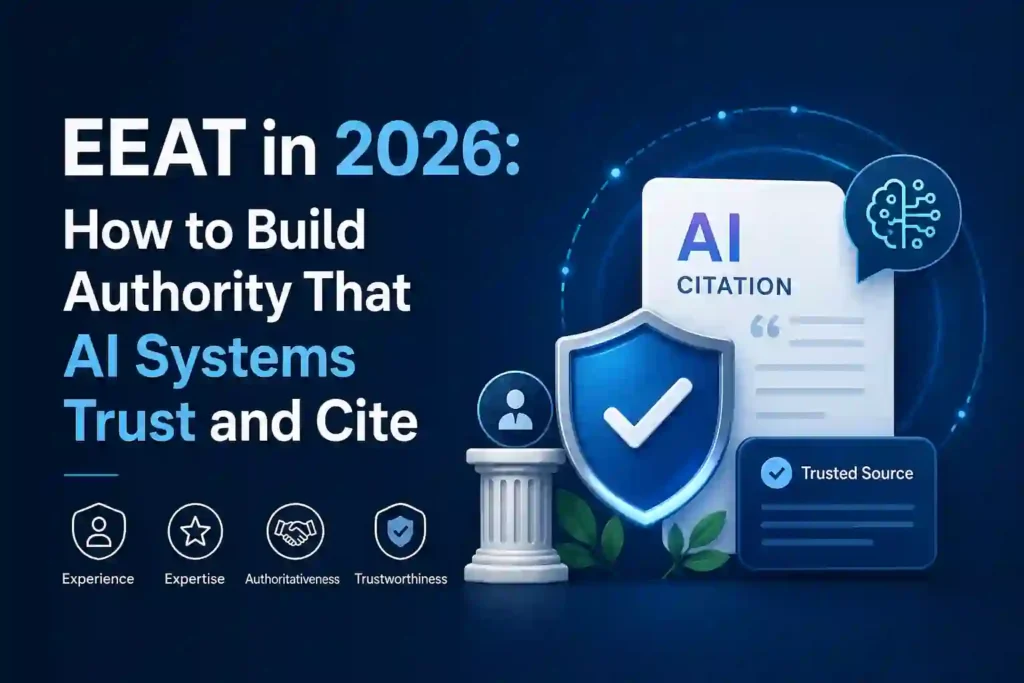
In 2026, EEAT is no longer just a Google ranking guideline — it is the single most important factor that determines whether AI systems like ChatGPT, Perplexity, Google AI Overviews, and Claude trust, surface, and cite your content. If you are not building EEAT authority deliberately, you are invisible in the new era of search.
Think about how search has changed in the past 12 months. Google AI Overviews now appear in roughly 50% of all searches. ChatGPT handles over 200 million weekly active users. Perplexity has become the default research tool for analysts, journalists, and technical buyers. When these platforms answer a question, they cite only a small handful of trusted sources — and everyone else gets nothing. Leapd
The rules have fundamentally shifted. Traditional SEO rewarded keywords and backlinks. In 2026, AI-powered search rewards credibility, real expertise, and verifiable authority. That is exactly what EEAT is built for.
EEAT in 2026: How to Build Authority That AI Systems Trust and Cite
What is EEAT and Why Does it Matter More Than Ever in 2026?
EEAT stands for Experience, Expertise, Authoritativeness, and Trustworthiness. It is Google’s framework for evaluating whether content is created by people with real experience and expertise, backed by external authority, and presented in a trustworthy environment. Savit
Here is what each pillar means in practice:
Experience — First-hand, real-world involvement with the topic. Did the author actually do, use, or live what they are writing about?
Expertise — Deep subject matter knowledge. Formal qualifications, credentials, or demonstrated mastery of the subject.
Authoritativeness — Recognition from others in your field. Backlinks, mentions, citations, and references from trusted sources.
Trustworthiness — Transparency, accuracy, and honesty. Clear authorship, cited sources, privacy policy, and no misleading claims.
In 2026, EEAT matters more than at any previous point because the flood of AI-generated content has made human-verifiable experience and institutional trust signals the primary differentiators between content that earns visibility and content that does not. Anyone can now publish fluent, well-structured content in seconds — but fluency is not accuracy, and AI systems know the difference. Redot Global
How AI Systems Use EEAT to Decide What to Cite
This is where 2026 is genuinely different from everything before it. EEAT was always important for Google rankings — but now it directly determines whether AI systems retrieve, summarize, and cite your content in their answers.
RAG-based systems (retrieval and generation) do not just generate answers from nowhere. They retrieve sources, summarize them, and sometimes cite them. That shifts the competition from who ranks to who becomes the source. If you are not trustworthy, you do not get retrieved. If you are not clear, you do not get used. If you are not specific, you do not get cited. ClickRank
Pages cited in AI Overviews earn 35% more organic clicks than non-cited competitors on the same results page. Visitors arriving from Perplexity convert at roughly 11 times the rate of traditional organic search traffic. The traffic stakes are very real. Leapd
Each AI platform sources content differently. Unlike ChatGPT’s hybrid of training data and selective web retrieval, Perplexity performs a real-time web search for every single query. New content can be cited by Perplexity within hours of being indexed. Visible year signals — including “2026” in titles and headings — improve citation rates by approximately 30%. Leapd
Proven Strategies to Build EEAT Authority That AI Systems Trust
- Build Strong, Verified Author Profiles
Every piece of content needs a real author with a detailed bio, credentials, social profiles, and links to other published work. AI recognizes your authority when actual experts create your content and you properly attribute it through structured data. Add Person schema markup to make author identity machine-readable. Revved Digital
- Create Original, First-Hand Content
Proprietary data, original surveys, benchmarks, case studies, and first-party research are more citable than recycled SEO summaries of what other people published. If your page is purely derivative, the retrieval system has no reason to prefer it over the authoritative original. AuthorityTech
- Structure Content for AI Extraction
Use short paragraphs of 2 to 3 lines, break down information with bullet points and numbered lists, lead each section with 1 to 2 sentences that answer the heading directly, and place key takeaways under H2s and H3s to help AI systems link questions with answers. Semrush
- Earn Citations from Trusted Sources
AI engines learn which sources are credible by looking at which sources cite which other sources. If a source the engine already trusts cites you in their content, the engine’s confidence in you goes up. The move is not to get cited everywhere — the move is to get cited by sources the engines already trust. Winstondigitalmarketing
- Maintain Consistent Brand Presence Across Platforms
AI systems cross-reference information across sources. If your product appears consistently across Reddit discussions, YouTube tutorials, industry publications, review sites, and your own website — all with similar positioning and messaging — AI systems gain confidence in recommending you. Sapt
- Update Content Regularly and Signal Recency
Perplexity cited content published within the last 30 days at an 82% rate in one 2026 analysis. A blog post from six months ago consistently loses to a fresh piece on the same topic. Add a “Last Updated” date, refresh your statistics, and update examples to reflect current reality. Leapd
EEAT Technical Checklist for 2026
On-Page Signals:
- Detailed author bio with credentials and social links on every post
- Person schema markup for all authors
- Clear publication date and last updated date visible on page
- Outbound links to authoritative references
- FAQ schema on relevant sections
- Article schema with author, publisher, and dateModified
- Contact, About, Privacy Policy pages clearly accessible
- Original data, images, or research included in content
AI Visibility Setup:
- Allow GPTBot, PerplexityBot, ClaudeBot, and Google-Extended in robots.txt
- Submit sitemap to Bing Webmaster Tools (powers ChatGPT Search)
- Ensure all key pages are crawlable by AI bots
- Use semantic HTML with proper heading hierarchy
- Monitor referral traffic from chat.openai.com and perplexity.ai
Frequently Asked Questions
Is EEAT a direct Google ranking factor? Technically no — EEAT is not a single algorithmic signal. But it shapes almost everything that performs well in search. Google’s Quality Raters use EEAT as a guide when reviewing content, and those assessments feed back into how Google updates its systems.
Does EEAT apply to AI-generated content? Yes. Publishing AI-generated content without adding human oversight or first-hand experience weakens expertise signals. AI content needs a credible human expert reviewing, adding genuine insights, and taking responsibility for accuracy. HYF Technologies
How long does it take to build EEAT authority? This is not a one-time project. It is an ongoing commitment to quality, transparency, and genuine expertise. Technical improvements like schema and author pages can show results in weeks. Building genuine authority typically takes 3 to 6 months of consistent effort. Savit
Which AI platform is easiest to get cited by? Perplexity is the most accessible for fresh content — it performs real-time searches and can cite content within hours. Google AI Overviews favor established domain authority. ChatGPT Search rewards semantic relevance and comprehensive topical coverage.
The Bottom Line
In 2026, search success is no longer about optimization alone. It is about credibility, clarity, and trust. EEAT decides which websites survive, grow, and dominate AI-driven search. Websites that focus on real experience, clear expertise, strong authority, and honest trust will own the future. Technoedgels
The window to build this advantage is open right now — but it is closing as more competitors catch on. Start building your EEAT authority today.
Ready to Master EEAT and AI Visibility?
Simplified eLearning offers practical, expert-led courses that teach you exactly how to build authority that search engines and AI systems trust in 2026. Learn SEO, Content Strategy, and Digital Marketing the right way.
